

The 2026 GSIB Surcharge Proposal: Halfway Back to the Future?
Sean Campbell, Sarah Flowers, W. Scott Frame, Felipe Rosa & Emma Tong
On March 19, 2026, the U.S. federal banking agencies issued a set of proposals to modernize the regulatory capital framework. [1] Included in this package is a proposal by the Federal Reserve to revise its U.S.-specific method of establishing risk-based capital surcharges for global systemically important banks (GSIBs). Underlying this method are a set of fixed parameters that have resulted in higher U.S. GSIB capital surcharges over time owing to economic growth rather than any increases in systemic importance.
This note highlights how the Federal Reserve’s recent proposal would only partially remedy this critical deficiency. We show that fully accounting for economic growth since the GSIB framework was originally calibrated would reduce capital surcharges, although the resulting levels would remain above Basel standards.
The U.S. GSIB Capital Surcharge Framework
In 2013, the Basel Committee on Banking Supervision (BCBS) finalized a framework for identifying GSIBs based on a scoring methodology and assigning capital surcharges tied to those scores. [2] Under the BCBS methodology, GSIB scores are derived from five equally weighted categories reflecting systemic importance (size, interconnectedness, complexity, cross-jurisdictional activity and substitutability), which are further subdivided into 12 systemic indicators. For each institution, indicator scores are calculated by dividing its own level of activity by the aggregate amount of activity across all large, internationally active banks. [3] The BCBS appropriately recognized that a market share approach is sensible because an increase in a bank’s activity that is proportionately matched by all other banks and reflects a growing economy does not signal any increase in systemic risk.
The U.S. implementation of the international standard requires banks to calculate GSIB scores under two methods, with the higher of the two serving as the binding surcharge. The first approach (“Method 1”) is effectively the standard established by the BCBS. If a bank is identified as a GSIB by Method 1, a second approach (“Method 2”) must also be calculated. Under Method 2, the substitutability category is replaced with a measure of reliance on short-term wholesale funding, which is intended to capture a bank’s susceptibility to funding stress and runs. [4]
Method 2 also differs in its scaling approach. First, it uses fixed denominators that were calibrated from average aggregate global banking activity for year-ends 2012 and 2013, to normalize the indicators for size, interconnectedness, complexity and cross-jurisdictional activity. [5] Second, it doubles the resulting indicator scores. Given the fixed nature of the Method 2 calibration, the Federal Reserve has published “coefficients” for each of the nine systemic indicators (i) based on the following formula:
GSIB Method 2 Coefficienti = [w / (Avg. Basel Denominatori,2012-13 * 1.335)] *10,000 * 2
where w refers to the indicator weight and 1.335 is an exchange rate conversion from euros to dollars based on average daily spot rates from 2011-2013.
An Increasing Problem with Fixed Denominators for Method 2
As discussed by Covas and Waxman (2020) and Campbell, Covas, and Zhang (2023), the use of fixed denominators (and hence coefficients) for the systemic indicators causes Method 2 GSIB scores to increase over time, driven by nominal economic growth and other factors unrelated to systemic risk.[6] As a result, a U.S. GSIB that maintained a constant global market share over this period would have seen its size indicator score under Method 2 increase by 29 percent, while remaining unchanged under Method 1. Thus, Method 2 scores inappropriately penalize banks for expanding in line with overall economic growth. Figure 1 shows the evolution of weighted-average U.S. GSIB scores over time.
Figure 1: Size-Weighted Average Method 1 and Method 2 U.S. GSIB Scores
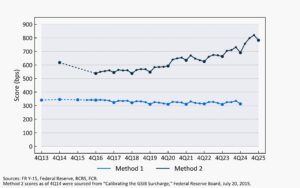
The Federal Reserve explicitly acknowledged the problem associated with using fixed coefficients in its final rule implementing GSIB surcharges in 2015. [7] However, it did not adopt a regular and ongoing mechanism to adjust them over time as the economy expanded. Instead, the Federal Reserve stated that it would “periodically reevaluate the framework to ensure that factors unrelated to systemic risk do not have an unintended effect on a bank holding company’s systemic indicator scores.”[8] This reevaluation did not occur until this year.
Federal Reserve Releases GSIB Surcharge Proposal
The Federal Reserve recently proposed revisions to its GSIB surcharge framework aimed at improving the measurement of systemic risk and better aligning surcharges with that risk. One key element of the proposal would modify Method 2’s fixed coefficients to: (i) reflect a portion of the growth in the economy and financial system since the framework was adopted in 2015; and (ii) introduce an automatic annual adjustment mechanism to account for future growth.
Notably, the proposal only partially updates the fixed coefficients to the present by applying a one-time 20 percent rescaling based on the divergence between the growth rates of Method 1 and Method 2 scores since the end of 2019. (Note this 20 percent does not reflect the growth in the U.S. economy since that time.) Figure 2 replicates a chart presented in the Federal Reserve’s GSIB surcharge proposal.
Figure 2: Percentage Changes in U.S. GSIB Aggregate Method 1 and Method 2 Scores (Base = 2019:Q4)
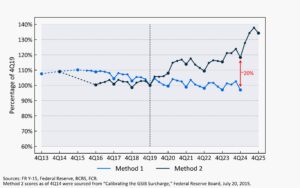
To restore the U.S. GSIB surcharge framework to a sound conceptual footing, it is necessary to account for all economic growth that has occurred since the end of 2012. The most straightforward approach would be to simply deflate the fixed coefficients by the 91 percent increase in nominal economic activity since that time.
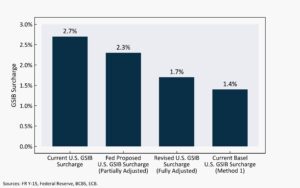
A full adjustment for economic growth would materially reduce GSIB surcharges relative to the partial adjustment contemplated in the Federal Reserve’s proposal. Figure 3 compares the 2026 average U.S. GSIB capital surcharge (2.7 percent) with the surcharge that would result under the Federal Reserve’s proposal (2.3 percent) and under a full adjustment for nominal GDP growth (1.7 percent). Notably, in each case, the surcharge would remain above the Basel standard as produced by Method 1 (1.4 percent).
Figure 3: 2026 U.S. GSIB Surcharge Comparison
Closing
The U.S. GSIB capital surcharge framework finalized by the Federal Reserve in 2015 significantly deviated from the Basel standard by maintaining fixed denominators for global market share calculations. Over time, this lack of alignment led to rising U.S. GSIB surcharges that reflect economic growth rather than increased systemic risk. The Federal Reserve has proposed to solve the problem in its GSIB Method 2 calculations by making a one-time 20 percent update to the fixed systemic risk indicator coefficients and through annual future adjustments for nominal economic growth. The proposed changes, while helpful and directionally consistent with appropriate regulatory policy, do not fully resolve the problem. The one-time 20 percent adjustment for economic growth falls significantly short of the 91 percent growth in nominal economic growth since the coefficients were calibrated. As the Federal Reserve moves to finalize revisions to its U.S. GSIB capital surcharge framework, it should account for the economic growth that has occurred since its original implementation.
______________
[1] See: https://www.federalreserve.gov/newsevents/pressreleases/bcreg20260319a.htm.
[2] See: https://www.bis.org/publ/bcbs255.pdf.
[3] The aggregate annual figures can be found at: https://www.bis.org/bcbs/gsib/denominators.htm. After converting the unit of account from euros to dollars, the Federal Reserve uses these same figures and publishes a table on its website showing the annual denominators for each systemic indicator. See: https://www.federalreserve.gov/supervisionreg/basel/denominators.htm
[4] As a result, Method 2 is based on 10 systemic indicators rather than 12.
[5] By contrast, the short-term wholesale funding measure is scaled using each bank’s average risk-weighted assets over the preceding four quarters.
[6] See: https://bpi.com/gsib-method-2-fixed-coefficients-must-be-adjusted-for-economic-growth/ and https://bpi.com/the-federal-reserve-should-revise-the-u-s-gsib-surcharge-methodology-to-reflect-real-risks-and-support-the-economy/, respectively.
[7] See 80 Fed. Reg. 49082 (August 14, 2015). “[T]he Board acknowledges that over time, a bank holding company’s method 2 score may be affected by economic growth that does not represent an increase in systemic risk. To ensure changes in economic growth do not unduly affect firms’ systemic risk scores, the Board will periodically review the coefficients and make adjustments as appropriate.”
[8] 80 Fed. Reg. 49082 at 49085.