

Large Bank Capital and Reality: Learning From the Past to Improve the Future
Introduction
Bank regulators have now begun a much needed and long-overdue review of the large bank capital framework. More than fifteen years have passed since the financial crisis that ushered in the wave of capital regulation that created the current regulatory regime. With much time and experience on which to draw, it is incumbent upon regulators to continue to assess the regime’s adequacy and make those adjustments that are needed to ensure that the regime serves its intended purpose: ensuring bank safety and soundness while supporting economic growth in a manner that does not create mountains of red tape that holds back the economy.
In this post, we discuss the recent capital proposals, put the expected capital changes in context, and discuss how the proposed changes better align the large bank capital regime with its intended purpose.
The Capital Proposals Represent Only a Modest Change in Large Bank Capital
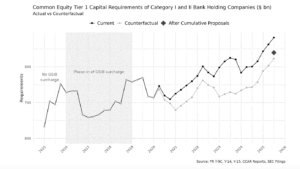
An initial reaction by some to the recent capital proposals is that they will significantly reduce capital levels and create undue risk in the financial system. The notion that the proposals will significantly reduce large bank capital is simply at odds with basic facts that are clearly laid out in the regulators’ proposals. The best evidence to dispel this misnomer can be found in a figure presented in the regulators’ Basel 3 Endgame proposal which we re-produce below.
https://www.govinfo.gov/content/pkg/FR-2026-03-27/pdf/2026-05959.pdf, page 15102
The solid line shows the dollar amount of minimum capital requirements for large banks from 2015 through 2025. In 2019, large banks were required to maintain roughly $750 billion in capital. Today, large banks are required to maintain roughly $880 billion in capital. Importantly, back in 2017 Jay Powell, the Chairman of the Federal Reserve stated that “U.S. capital standards are about right now.”
As shown in the chart, large bank capital requirements have risen by about $200 billion, or roughly 30 percent, since 2017 when Chairman Powell indicated that capital was “about right.” The significant rise in capital can be traced to a variety of factors including an improperly calibrated GSIB surcharge that mechanically increased as the Federal Reserve and U.S. Treasury massively increased the supply of safe and liquid assets in the U.S. financial system in response to the COVID crisis.
So how much will capital decline because of the regulators’ capital proposals? The diamond-shaped mark in the figure shows the Federal Reserve’s estimate of the resulting decline in capital. Looking at the chart shows that capital levels will decline by roughly $40 billion, or roughly five percent, from about $880 billion to $840 billion.
It is helpful to put the $40 billion decline in perspective. The data in the graph are quarterly, and the sample period ends in the second quarter of 2025. Looking at the chart shows that large bank capital levels increased by about $40 billion over the last two quarters of the sample period (2025Q1 – 2025Q2). Accordingly, the proposal will return large bank capital requirements to roughly the same level that was reached at the end of 2024 instead of the level experienced in the second quarter of 2025. A two-quarter retrenchment in capital growth can hardly be characterized as “concerning” and the resulting capital levels will still be far above those that were in effect when Chair Powell characterized large bank capital as “about right.”
The Capital Proposals Address Longstanding and Well-Documented Problems that Stifle Economic Growth
The large bank capital regime has effectively been in a state of “suspended animation” since 2010. Fifteen years is a very long time for any complex system to remain in place without any updating or modernization. Just think of how often your smart phone’s operating system needs to be updated!
Over time, data and experience has revealed several important shortcomings with the capital regime that have led to requirements that are not appropriately risk-sensitive, incentivizes less well-regulated non-banks to increase their footprint and risk profile, creates a competitive disadvantage with our foreign competitors, and holds back growth and innovation in our economy. The list of identified shortcomings is long, but a short list of well-known weaknesses in the capital regime would include:
- A GSIB surcharge rule that has not been updated for economic growth since 2015 and unnecessarily raises the cost of credit in the US economy while making it more difficult for US banks and businesses to compete abroad.
- A stress testing framework that is opaque and excessively volatile making it difficult and costly to fund important institutions in our economy such as small businesses and hospitals.
- An outdated risk-based capital system that treats all corporate borrowers as though they are high-risk, thereby increasing the cost of and reducing the availability of corporate credit.
The Capital Proposals Are Backed by Extensive Data-Based Analysis That Will Improve Bank Safety and Soundness While Supporting Economic Growth
The outstanding capital proposals are remarkable in the extent and substance of the economic analysis that has driven the proposed modifications. In crafting these proposals, the regulators took a data-based approach to improving the capital regime. This approach to capital reform is good news and should be applauded.
Appropriate bank capital requirements are important to support stability in our financial system. At the very same time, capital is not a free resource. As in all things, the cost of heightened capital requirements must be balanced against the benefits. Capital requirements should always be designed to be risk-sensitive to ensure that banks can serve their important function of channeling savings into investment. Ultimately, a data-driven risk-sensitive capital regime is one that benefits both financial stability and growth.
Conclusion
After a lengthy period of dormancy, bank regulators have begun the important work of updating the large bank capital regime to reflect today’s economy rather than the economy that existed in 2010. A regular re-evaluation of important public policy, whether it be monetary policy, tax policy, or bank capital policy is a sign of a healthy regulatory system that seeks to serve the economy by improving and growing with the times. To the contrary, a static capital regime that is overly bureaucratic and unchanging risks both heightened financial instability and a lethargic economy.
The proposed changes to large bank capital will result in a modest decline in capital that amounts to reversing two quarters of capital growth. Over the last decade, required bank capital grew by over $200 billion. The resulting level of capital will still be far more than the level that obtained in 2017 when Chairman Powell stated that capital levels are “about right”.
As the regulators seek comment on these capital proposals, we should all stay focused on the facts and think clearly about what the experience of the past fifteen years has taught us about the large bank capital framework. Alarmism and hyperbolic claims about the impact of these proposals that are disconnected from basic facts and data-based analyses will do nothing to improve our economy and financial system. Ultimately, we should all make a good faith effort to learn from our past and improve the large bank capital framework to strengthen our economy.