

Introduction
Last month the Federal Reserve published the results of its annual stress test exercise. Since the financial crisis, the Federal Reserve has been using the stress test to annually gauge the resilience of the banking sector to adverse economic conditions. While the specific form and features of the stress test are quite complex and can be difficult to interpret from one year to the next, there are some broad lessons that can be drawn from the stress test results. In this blog, we use the results of the stress tests to quantitatively demonstrate the well diversified nature of Forum (FSF) members. The broad and well-diversified nature of Forum members is a critical source of resilience that supports financial stability and their ability to support a diverse economy during periods of stress.
Diversification: Theory and Practice
The notion of diversification and its link to resilience is intuitive. Being diversified means maintaining balanced exposure to several different sources of risk and return. Each individual area of focus can deliver value, while maintaining a balanced portfolio of activities ensures that problems in any one area will not threaten the whole enterprise. As the old adage goes, it’s often a good idea to “spread your eggs among many baskets”. Diversification is a key risk management concept that pervades various fields such as investing, banking, and real estate.
While the general concept of diversification is easy to grasp, measuring it in a precise and systematic fashion can be difficult. Often, diversification is measured with respect to technical measurements of “volatility” and “correlation” which can be difficult to relate back to the fundamental notion of “spreading your eggs”.
The stress test results, however, provide helpful data that can be used to intuitively and systematically measure diversification. Each year the stress tests produce an estimate of financial losses that would occur in a period of severe economic stress. Importantly, the stress tests estimate bank losses across an array of different banking activities such as corporate lending, credit card lending, commercial real estate lending, and trading activities. In all, the Federal Reserve estimates bank losses across ten different banking activities.
The data on the composition of losses across these banking activities provides an intuitive and rigorous basis for measuring diversification. A bank that is subject to losses that are spread across a range of different business activities is better diversified, and more resilient than a bank whose losses are concentrated on a small number of business activities.
Consider the following stylized example laid out in the figure below. Two banks, Bank A and Bank B, are estimated to experience $100 in total losses. Bank A’s losses are driven exclusively by losses in commercial real estate (CRE) lending. Bank B’s losses are evenly distributed across three banking activities – CRE lending, business lending (C&I), and trading activities. Clearly, Bank B is better diversified than Bank A. If the CRE sector goes into a tailspin, Bank A will be heavily exposed to losses. Bank B will face some losses from a souring CRE sector too, but its financial condition will be buoyed, to some extent, by earnings from business lending and trading activities.
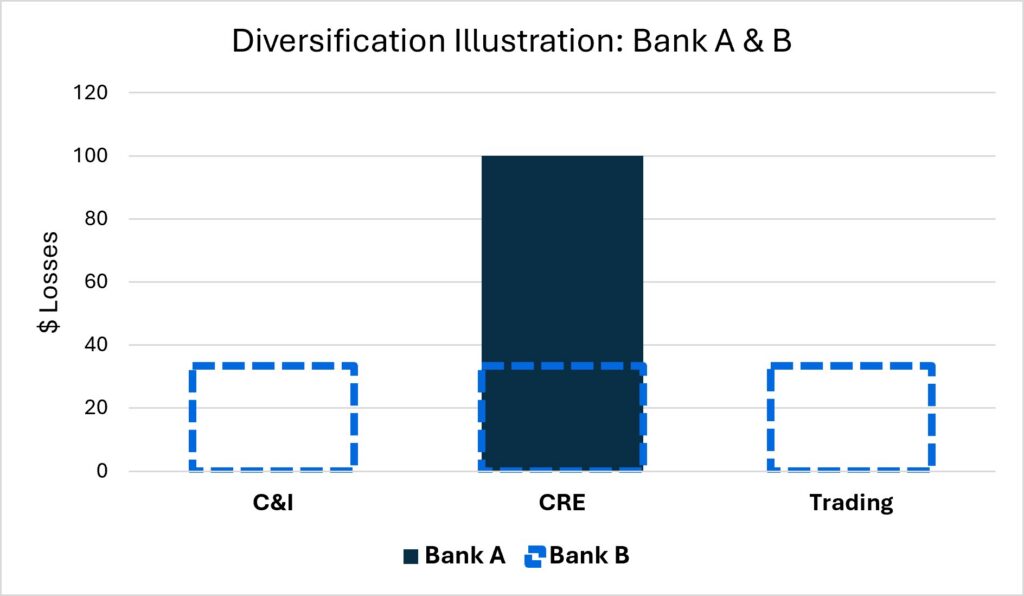
While the figure above is intuitive, it does not lend itself to easy quantification. Essentially, we need to translate the basic truth evident in the figure into a single number. This can be achieved by using what is known as a Herfindahl Index (HI). The HI is calculated by taking the share of losses in each category, squaring it, and then summing up the squared shares. In the case of Bank A this is a snap as all its losses are concentrated in a single activity and so HI for Bank A is simply 1002 =10,000. In the case of Bank B the HI is 332 +332 +332 =3,267. As you can see, the higher HI of 10,000 signals less diversification while the lower HI of 3,267 signals greater diversification. Accordingly, a lower HI signals greater diversification and vice versa.
What Do the Stress Tests Tell Us About Diversification in the Banking Sector?
We analyze the results of the Federal Reserve stress test results from 2013-2026 to calculate HI indexes for each of the banks included in the stress tests. Each year the stress test includes about 30-35 large banks that operate in the U.S. Our HI index is based on ten separate loss categories and so while the maximum HI index is still 10,000 the minimum attainable HI index is 1,000.
In the figure below we plot the average HI for Forum members versus the average HI for all other banks included in the stress tests from 2013-2026.
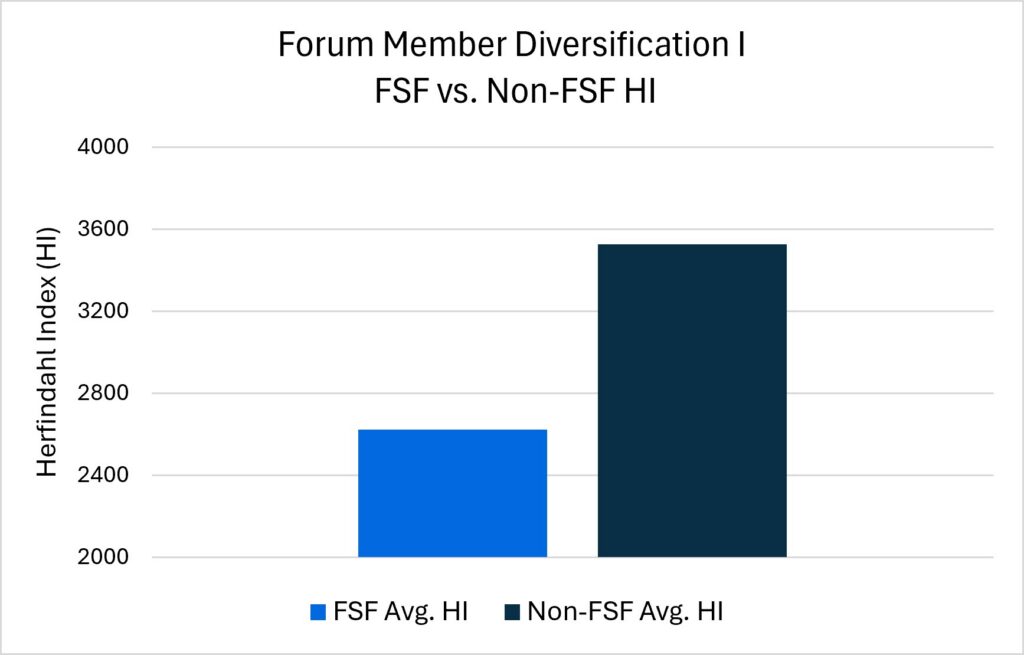
As shown in the figure above, the average degree of diversification, as measured by HI, is significantly higher (represented by a lower HI) for Forum members (HI=2,622) than other banks (HI=3,526). Of course, averages can sometimes mask important variability. Accordingly, it is instructive to look at the full distribution of HI scores across Forum and non-Forum banks in the stress test. In the figure below, we present a standard “box and whisker” plot that depicts the full range of HI scores for Forum and Non-Forum banks over the 2013-2026 period.
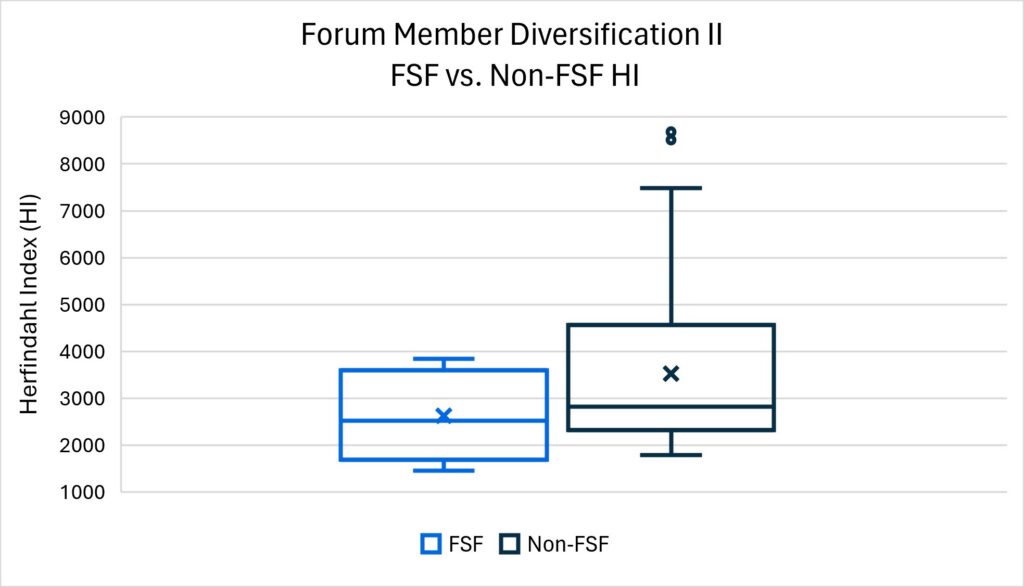
The “box” in each plot represents the 25th percentile (bottom) HI and 75th percentile (top) HI. The line through the box represents the median (50th percentile) HI. The “X” in the box represents the average HI. Finally, the “whiskers” represent the more extreme ends of the distribution of HI. The box and whisker plot conveys information about the range of HI scores that can’t be depicted by averages alone.
Looking at the figure clearly shows that the Forum “box” is shifted down, meaning lower HI scores and greater diversification, relative to the non-Forum “box”. While it is certainly the case that some non-Forum banks are as well-diversified as Forum members, overall the figure clearly shows that Forum members tend to be better diversified than non-Forum members. Also, at extremes, the figure shows that the least well-diversified non-Forum banks, represented at the top of the “whiskers” have substantially higher HI scores and are therefore substantially less well-diversified than Forum members.
Diversification, Financial Stability, and Economic Diversity
The data from the Federal Reserve’s stress tests clearly document that Forum members are well-diversified. Diversification is important from a financial stability perspective because banks with multiple sources of revenue (and loss) are better able to withstand losses in any particular business segment. As just one example, recent coverage of the private equity industry has noted that large banks make loans to private equity firms, but also rightly acknowledge that the proportion of large bank activity in private equity relative to their overall banking activity is small. Accordingly, bank losses in private equity are unlikely to have far reaching effects on the banking sector given the highly diversified nature of large banks that operate in this sector.
In addition to the standard financial stability benefits of diversification, it is important to recognize that large, well-diversified banks support a diverse economy with a varied array of different activities, businesses, and investment opportunities. To the extent that diverse economies tend to be robust and thriving, large, well-diversified banks that serve a wide array of constituents are important to the growth of our economy.
Conclusion
Broad and well-diversified banks support financial stability and a thriving economy. The Federal Reserve’s stress tests provide useful information on the degree of diversification among large banks. Using the stress test results between 2013-2026 we have documented that Forum members are among the most well-diversified banks that are included in the stress tests. The highly diversified nature of Forum members contributes to a safe and sound financial system while also supporting a diverse and robust economy.