

Introduction
Private credit has gained much attention in the past several years as its rapid rise has raised important questions about its role as a source of corporate lending to the U.S. economy. Until recently, our ability to understand this fast-growing sector was hampered by a lack of consistent, systematic data for measuring private credit across the economy and over time. This month, the Federal Reserve announced that it was revising its quarterly assessment of the financial system to include a new private credit sector. The addition to the Federal Reserve’s Financial Accounts provides policymakers, researchers, and the public with a consistent source of data to track the growth of private credit and assess its relationship with the broader economy. In this blog, we use these newly available data to highlight important trends in private credit and discuss the relationship between private credit, the banking system, and financial stability.
What is Private Credit?
Private credit is privately negotiated lending by nonbank investment funds, often to midsize businesses known as “middle-market companies.” Federal Reserve data defines the private credit sector as including private debt funds, business development companies, interval and tender offer funds, and “middle-market” collateralized loan obligations, or “CLOs.” The figure below shows lending by the private credit sector since 2012. For comparison, we show the amount of commercial and industrial (C&I) lending provided by banks over the same period.
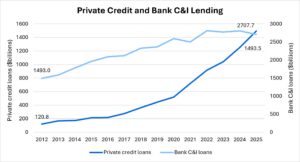
As shown in the figure, private credit has grown dramatically from just over $100 billion in 2012 to about $1.5 trillion at the end of 2025, more than 12 times its 2012 level. Over the same period, bank C&I lending has increased, but at a much more moderate pace, to about 1.8 times its 2012 level.
Why Has Private Credit Grown So Rapidly?
The significant rise in private credit lending has raised important questions about the source of its growth. In particular, why has private credit grown so rapidly while bank lending has increased at a more moderate pace?
Like any complex phenomenon, multiple forces are at play. One important force driving the increase in private credit is bank regulation. After the 2008 financial crisis, regulators tightened bank capital, liquidity and supervision requirements, arguably making lending to the smaller, riskier firms served by private credit more challenging. Recent research highlights the role that regulation played in shifting lending to smaller and riskier firms away from banks to private credit. One recent study found that “regulators’ concerns about the leveraged loan market had the unintended effect of reducing banks’ willingness to lend to highly leveraged firms with maintenance covenants…The role of banks in issuing risky loans with maintenance covenants has been replaced in part by private credit.”
How Does $1.5 Trillion in Missing Loans Change Our View of the Banking Sector?
The addition of the new private credit sector changes our understanding of the role that banks play in providing lending to the economy. For decades, banks’ share of lending has steadily declined relative to nonbank lenders such as insurance companies, pension funds, government-sponsored enterprises, and asset-backed securitization vehicles. The addition of the private credit sector uncovers what was previously a “missing sector” that went unmeasured in the Federal Reserve’s Financial Accounts. The chart below shows how recognizing this “missing sector” changes our understanding of the importance of the banking sector in providing lending to the U.S. economy.
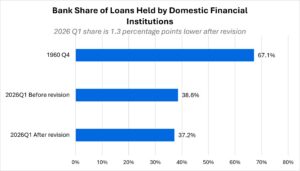
The top bar in the chart shows that in 1960, banks accounted for roughly 67% of all loans made by the domestic financial sector. Moving ahead to today, before the recognition of the private credit sector, the middle bar in the chart shows that the bank share of lending declined significantly to roughly 39%. This decline is a well-documented consequence of the significant growth in nonbank lending over the past six decades. Once we incorporate the previously “missing sector” of private credit, the share for the same quarter declines further to roughly 37%. The updated Financial Accounts data paint a fuller picture of the lending landscape in which banks have lost even more ground to nonbank lenders than previously recognized. The data suggest that the nonbank lending sector is larger than previously recognized, which may heighten policymakers’ focus on the financial stability risks of a rapidly growing nonbank sector.
What is the Link Between Private Credit and the Banking Sector?
While private credit represents lending that occurs outside the banking sector, banks still play a role in the provision of private credit. Specifically, banks lend to private credit vehicles. Bank loans to private credit vehicles are used to fund some of the lending made by private credit vehicles and also serve as a source of liquidity to fund investor redemptions. Some commentators have raised concerns about the interlinkage between private credit and the banking sector. The new private credit data can be used to shed light on the scale of this linkage. The chart below shows bank lending to U.S.-domiciled private credit vehicles as a proportion of their total funding and as a percentage of all bank loans.
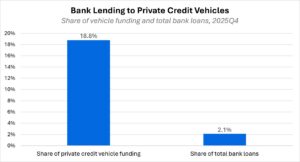
As shown in the bar on the left, bank lending to private credit represents less than 20 percent of total funding for these private credit vehicles. The lion’s share of their funding is provided by investor equity rather than bank funding. The bar on the right shows that lending to these vehicles amounts to roughly 2% of all bank lending. Accordingly, while banks do lend to the private credit sector, the exposure is modest relative to banks’ overall lending activity.
In addition to the fact that bank lending to private credit is relatively modest, it is also important to consider that these bank loans are typically secured by collateral and provide the sector with access to liquidity from a stable and well-regulated banking system that may help alleviate funding stresses during periods of volatility. Viewed from this vantage point, bank lending to private credit can serve as a stabilizing force within the rapidly growing private credit market.
Conclusion
Private credit is a new and rapidly evolving source of nonbank lending. Until now there were no comprehensive and consistent data sources that could be used to systematically monitor the private credit sector. The Federal Reserve’s addition of the private credit sector to the Financial Accounts represents a significant advance in the ability of policymakers, researchers and market participants to better understand its role in the broader financial system and economy. In this blog, we have used these data to shed light on key characteristics of private credit and its connections to the banking system. Going forward, policymakers should make use of this new data source to better understand the evolution of private credit, its interactions with other parts of the financial system and any implications for economic and financial stability.