

Introduction
Since it was founded in 1913, the Federal Reserve’s discount window has been a source of liquidity support for banks that promotes broader financial stability. Forum members have utilized the discount window, including during periods of stress such as the Covid-19 pandemic, in a manner that promotes a safe and sound banking and financial system. Modernizing the discount window to make it easier to use and more effective as a source of liquidity for the banking sector is an important financial stability initiative. As part of the modernization effort, regulators should acknowledge the role the discount window plays as a liquidity resource in the large bank liquidity framework. In this blog, we provide a brief overview of the Federal Reserve’s discount window, discuss its use during the COVID-19 pandemic as well as less volatile periods, and examine how access to the facility should be reflected in regulatory and supervisory assessments of bank liquidity levels.
What is the “discount window” and why does it matter?
The Federal Reserve was founded in 1913 following the banking panic of 1907. The panic of 1907 witnessed a wave of bank runs in which banks failed because of a lack of cash resources to stem deposit outflows. The resulting economic contraction was surpassed in severity only by the Great Depression.
A foundational rationale for the Federal Reserve was to create an institution that would provide sound banks with a source of temporary liquidity when depositor demands for currency outstripped a bank’s available supply of cash. How? By lending cash to banks against collateral provided to the Federal Reserve to secure the borrowing. As an example, a bank experiencing a large, temporary deposit outflow of, say, $10 million could pledge a portfolio of high-quality loans to the Federal Reserve with a value of $11 million and receive $10 million in cash. Later, once the deposit flow had abated and conditions had normalized, the bank could repay the loan, with interest, and take back the portfolio of pledged loans.
The Federal Reserve’s “discount window” lending created what was referred to as an “elastic currency” so that the amount of currency in circulation could expand when currency demands were elevated and then contract once peak demand had subsided. Since its inception, discount window lending by the Federal Reserve has served a critical role in supporting a sound banking system and a stable economy.
How have Forum members used the discount window in prior stress periods?
The discount window has primarily been viewed as a liquidity resource to be used by banks during times of stress. When markets and the economy are operating normally, banks typically manage their liquidity needs using their own cash resources or private funding markets.
During stress, however, the Federal Reserve’s discount window can act as a stabilizing force for the economy. The Covid-19 pandemic provides a useful case study. During the Covid-19 pandemic, the financial system came under acute strain as the rapid spread of the virus resulted in a mass shutdown of the economy and uncertainty spiked.
As the Covid-19 pandemic intensified, the Federal Reserve and other bank regulators, publicly encouraged banks to use the discount window as a source of liquidity. The next day, on March 17, 2020, Forum members publicly announced their intention to borrow from the discount window to demonstrate “the value of the Federal Reserve’s discount window facility and to encourage its use by other financial institutions.”
As shown in the chart below, total new discount window borrowing reached $50.6 billion in the week ending March 22, 2020. Forum members accounted for roughly $11 billion of that total, while other banks in the system borrowed roughly $40 billion. This far exceeded the level of borrowing that had been observed in prior months, due to the heightened need for liquidity resulting from the Covid-19 pandemic. Later that week, the Federal Reserve issued a press release stating it was “encouraged by the notable increase in discount window borrowing” and welcoming banks’ use of the facility to support credit to households and businesses.
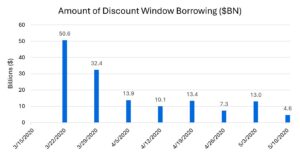
As shown in the chart above, borrowing remained elevated after the initial spike in the week ending March 22, 2020. The longer view below shows that, although borrowing declined from its peak, it remained above its pre-pandemic level through 2021.
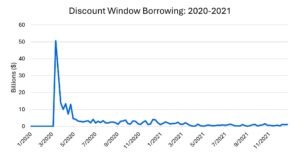
While the level of discount window borrowing clearly subsided after March 2020, average weekly borrowing in late 2021 was approximately $770 million, roughly 30 times the average in the weeks before March 16, 2020. Accordingly, the burst of borrowing activity that occurred in March 2020 appears to have had lasting effects on overall borrowing behavior.
How do Forum members use the discount window during normal times?
While the discount window is naturally more likely to be used during a period of stress, there are also benefits to using the discount window during normal times. Importantly, just as a homeowner should regularly test their smoke alarm so that it can be relied upon in the event of a fire, regular draws from the discount window that test operational readiness are a valuable means of ensuring that discount window liquidity can be accessed on a timely basis.
The chart below shows the average annual number of discount window borrowing records per Forum member compared with the average number of borrowing records per bank across the banking sector. As shown, Forum members regularly access the discount window, demonstrating their capacity and capability to access the facility when needed.
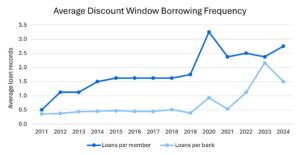
Note: Member frequency is annual borrowing records divided by eight member groups. Banking-sector frequency uses average quarterly counts of FDIC-insured banks and savings institutions and includes members. Figures for 2024 cover January–September.
Discount Window Access and Large Bank Liquidity Requirements
As discussed above, the discount window is a valuable source of liquidity for the banking system that improves its safety and stability. When gauging the overall adequacy of a bank’s liquid resources, it is appropriate to consider all of the liquidity resources that a bank can access. The Federal Reserve provides a backup source of liquidity, and banks, including Forum members, have made use of that liquidity when needed. Consequently, it is both reasonable and appropriate for discount window access to be factored into regulatory and supervisory assessments of large bank liquidity. Of course, conditioning such recognition on the operational and administrative capability of a bank to access the window and pledge qualified collateral is also reasonable and appropriate. As discussed above, Forum members regularly test their ability to access the window and pledge collateral.
Conclusion
The Federal Reserve’s discount window is an important tool in its mandate to support a safe and sound banking system. Forum members and other banks have made use of the discount window during periods of stress and at other times when banks have needed for short-term liquidity. Regular testing also helps banks maintain their operational readiness to access the discount window. Accordingly, discount window borrowing plans play a role in the overall liquidity planning of the banking sector. As a result, regulatory and supervisory assessments of the adequacy of bank liquidity should account for the ability of banks to access the Federal Reserve’s discount window.