

The Fed’s Balance Sheet, Bank Liquidity Requirements, and Lending: Water, Water Everywhere but Not a Drop to Drink?
Introduction
In a recent speech, Governor Michael Barr suggested that Fed policy does not incentivize banks to hold liquid bank reserves rather than lend to households. In the same speech, he also indicated that the events of 2023 show bank liquidity requirements should be higher than they are today. In this blog, we explain why both claims are misguided. The “right” size of the Fed’s balance sheet is an important and complex public policy issue. Getting it right should be a top priority for the Federal Reserve and choices about the size of the Federal Reserve’s balance sheet should not be shaped by dubious claims that obscure more than they clarify.
The Fed’s Large Balance Sheet is Affecting Bank Lending
In his speech, Governor Barr asserted that the Fed’s large balance sheet does not affect bank lending. Specifically, he stated that “because banks receive an interest rate on reserves that reflects safe asset status, banks are also not gaining excessive returns on holding reserves, so they have no incentive to load up on reserve holdings at the expense of lending to businesses and households.” This statement is misleading because it ignores the structural demand for bank reserves that has been deliberately created through the imposition of bank liquidity requirements. The Fed then actively accommodates this increased structural demand by supplying a large supply of safe assets, in the form of bank reserves, that then crowds out some amount of bank lending.
Today, as a direct result of post-crisis liquidity requirements, Financial Services Forum members are required to hold more than $3 trillion in “high-quality liquid assets” or “HQLA”. To put this in perspective, the aggregate liquidity requirements of Forum members exceed the size of the Fed’s entire balance sheet in 2012. Bank reserves are a primary component of HQLA. Large banks typically hold about 40 percent of their required HQLA in the form of bank reserves.
When a bank is required to hold a bank reserve, those holdings naturally crowd out loans that a bank might otherwise make to a household or business. The chart below shows the ratio of loans to assets for large and smaller banks between 2000 and 2025.
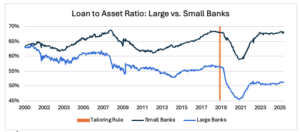
Source: Federal Reserve Board H.8 – Assets and Liabilities of Commercial Banks in the U.S.
As shown in the chart, the proportion of large bank assets devoted to lending has trended down since 2008-2009. Today, large banks hold just over 50 percent of their assets in loans down from about 60 percent of their assets as loans in 2007. Smaller banks show a different pattern. Both today and in 2007, smaller banks held roughly 65 percent of their assets in loans.
Why has small bank lending activity remained roughly unchanged while large banks have seen a decline? Large banks are subject to higher and more stringent liquidity requirements than smaller banks. Today, banks below a certain size are not required to comply at all with liquidity requirements such as the Liquidity Coverage Ratio (LCR). Also, in 2019, regulators further softened liquidity requirements through “tailoring” that reduced the stringency of the LCR for certain banks with total assets below $700 billion. The loan to asset ratio for smaller banks indeed shows a small uptick in the loan to asset ratio since 2019 when liquidity requirements were further relaxed for smaller banks (68.1% in 2019 vs. 68.3% at the end of the sample period).
The other side of the “loan to asset” coin is the ratio of HQLA to total assets maintained by large and small banks. The chart below is taken directly from the Federal Reserve’s financial stability report and shows the HQLA to asset ratio for large and small banks since 2000.
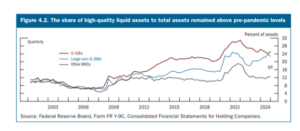
The data in this chart shows an even sharper divergence. In 2007, large and small banks each held roughly five percent of their assets in bank reserves and other forms of high-quality liquid assets. Today, large banks maintain fully 25 percent of their asset base in HQLA while smaller banks maintain roughly 12 percent of their asset base in HQLA. The divergence between large and small banks is striking. And while there may be multiple economic forces at play, clearly, stringent bank liquidity requirements for large banks are part of the story as they create structural demand for bank reserves. This structural demand is then accommodated by the Fed’s large balance sheet. Accordingly, the Fed is creating the demand that they then supply by maintaining a large balance sheet. As a result, it is misleading to suggest that the Fed’s large balance sheet does not disincentivize lending because regulatory policy directly contributes to structural reserve demand that the Fed satiates by growing its balance sheet.
The Events of 2023 Do Not Suggest That Liquidity Requirements Should be Higher
Governor Barr’s speech also claims that the events of 2023 indicate that, if anything, bank liquidity requirements should be increased. Specifically, he states that “the bank stresses of 2023 suggest that liquidity requirements should go up and not down, as I have discussed in a number of previous speeches.”
This statement is highly misleading, at least to the extent that the statement is silent about which banks should be subject to higher liquidity requirements. In 2023, mid-size and smaller banks experienced a liquidity crunch as some depositors switched to larger banks with greater observable liquidity, capital, and stability. Large banks then used their excess liquidity to support the banking system – clear evidence that the inflow of liquidity was not needed to shore up their own liquidity position. Specifically, a consortium of 11 large banks made a $30 billion deposit in First Republic Bank. At the time, bank regulators and the Department of the Treasury publicly announced that the “show of support by a group of large banks is most welcome, and demonstrates the resilience of the banking system.” Accordingly, it is both contrary to prior public statements and actual historical events to suggest that the events of 2023 demonstrate anything but robust liquidity conditions among our nation’s largest banks.
Conclusion
Bank liquidity is critical to a safe and stable banking system. Over the past fifteen years, regulators have intentionally created a source of structural demand for bank reserves through binding bank liquidity requirements. As bank regulators have created a source of demand, the Fed has accommodated the increase in demand by significantly growing its balance sheet and supplying a large level of bank reserves. One might refer to this approach as the “build it and they will come” theory of central bank balance sheet management. As large banks have been required to hold ever larger amounts of liquidity, pressure has been put on their ability to channel deposits into loans. Instead, deposits are increasingly being channeled into central bank reserves and other U.S. government-backed assets. Finally, in 2023 large banks showed remarkable resilience, liquidity, and support for the U.S. economy. These events should not be used as a pretext for tighter large bank liquidity requirements.